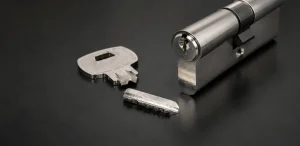
There are few sounds more sinking than the sharp snap of metal giving way when you are trying to open your front door. It usually happens at the worst possible moment: perhaps you are juggling groceries in the freezing rain in Pittsburgh, or coming home late after a shift in Philadelphia. You look down at your hand and see only the bow of the key, while the blade remains stubbornly buried inside the lock cylinder.
Panic is the natural first reaction, but it is the enemy of a successful extraction. If your key has broken off in the lock, the situation is salvageable. However, the difference between a minor annoyance and a destroyed deadbolt often comes down to what you do in the first sixty seconds after the break.
The Golden Rule: Stop and Assess
Before you run to the garage for tools or try to re-insert the broken piece to “turn it the rest of the way,” stop. The most critical mistake homeowners make is pushing the broken fragment deeper into the keyway.
Modern locks, and even the older mortise locks common in Pennsylvania’s historic districts, operate on precise tolerances. If you shove the broken piece deeper, it may engage the rear pins or settle past the shear line in a way that makes non-destructive removal impossible. Take a deep breath, pull out your phone flashlight, and look closely at the keyhole. Your next move depends entirely on how deep the break occurred.
Scenario A: The Fragment is Visible
If you are lucky, the key snapped due to torque on the head, leaving a small sliver of the brass blade protruding from the lock face. This is the best-case scenario.
In this instance, you need precision, not force. Standard pliers are often too bulky to grip a thin sliver of brass without pushing it inward. Instead, look for needle-nose pliers or, even better, a pair of high-quality tweezers.
The goal is to pinch the exposed metal firmly. Do not try to twist the key fragment yet. If the lock is stiff, which is likely the reason the key broke in the first place, twisting the weak fragment will only cause it to snap again, this time flush with the lock face. Instead, pull the fragment straight out with a slow, steady motion. If the lock cylinder itself is turned slightly (not in the vertical 12 o’clock position), you may need to use a small screwdriver to gently rotate the cylinder back to the neutral position before pulling.
Scenario B: The Fragment is Deep Inside
If the metal is flush with the lock face or buried inside, tweezers will not help you. This requires a tool that can hook the key from behind. While professional locksmiths use specific “key extractor tools,” you can replicate this at home using a thin jigsaw blade or a scroll saw blade.
These blades work because they are made of hardened steel (stronger than your brass key) and have serrated teeth. Insert the blade into the keyway alongside the broken key fragment. The teeth of the blade should be facing the key. Once the blade is inserted as far as it can go, twist it slightly so the teeth dig into the softer brass of the key. Then, pull outward. The idea is for the serrations to act as a barb, dragging the broken key out with the blade.
This requires patience. You may have to try three or four times to get a solid grip. If you don’t have a saw blade, a small, stiff wire (like a bobby pin) with a tiny hook bent onto the end can sometimes achieve the same result, though it lacks the grip strength of a serrated blade.
The “Super Glue” Trap: A Warning
In the age of internet life hacks, you may find advice suggesting you put a dab of super glue on the end of the broken key half, insert it into the lock, wait for it to dry, and pull the whole thing out.
Do not do this.
When you insert it into the tight confines of a keyway, it inevitably spreads. It will seep into the pin chambers and springs, effectively welding the internal mechanism of your lock into a solid block.
If you use super glue, you turn a $100 extraction job into a situation where the entire lock must be drilled out and replaced. It ruins the hardware permanently.
Why Does This Happen? The Pennsylvania Context
Why do keys seem to break more often in Pennsylvania than in other regions? The answer usually lies in the intersection of metallurgy and weather.
- The Freeze-Thaw Cycle: Pennsylvania winters are notorious for fluctuating temperatures. When the temperature drops below freezing, the metal inside your lock contracts. Simultaneously, any moisture inside the lock, from humidity or freezing rain, can freeze, making the tumblers incredibly stiff. At the same time, your key is likely made of brass or a nickel-silver alloy. In extreme cold, these metals lose some of their ductility and become brittle. When you apply force to a cold, brittle key inside a frozen, contracted lock, the metal reaches its breaking point much faster than it would in July.
- Historic Wear and Tear: Pennsylvania has some of the oldest housing stock in the country. Many homes in our area still utilize locks that are decades old. Over time, the internal pins of these locks wear down, and the keys themselves become rounded and smooth. This wear creates a sloppy fit. Eventually, the key no longer aligns perfectly with the shear line. When you turn it, the key catches on a pin rather than sliding smoothly, creating a stress point that eventually snaps.
Prevention: Lubrication and Maintenance
The best way to handle a broken key is to prevent it from happening. If your lock feels “sticky” or requires you to jiggle the key to get it to turn, it is asking for help.
Your instinct might be to grab a can of WD-40. Avoid this. Standard WD-40 is solvent-based; while it works initially, it eventually evaporates and leaves behind a sticky residue that attracts dust and dirt, gumming up the lock worse than before.
For Pennsylvania winters, you want a “dry” lubricant. Graphite powder is the traditional choice, but PTFE (Teflon) sprays are the modern standard. These lubricants coat the metal parts without attracting dust and repel moisture, preventing the freezing issues common in our climate.
Additionally, inspect your keys. If you notice a crack forming near the head of the key, or if the key is bent, stop using it immediately. Visit a local hardware store and have a new key cut from the original code or a spare, rather than duplicating the damaged key.
When to Call a Professional
There comes a point where DIY efforts yield diminishing returns. If the key is broken deep inside the lock and the cylinder is turned to a locked position, it is very difficult to extract without professional tools.
If you have tried the extractor method for 15 minutes without success, or if you feel yourself getting frustrated and applying excessive force, it is time to call a professional locksmith. U.S. Premier Locksmith offers fast and reliable Lockout Services, Broken Key Extraction, and Car Key Remote Replacement Services, ensuring your lock is safe from damage.
A licensed locksmith has specialized tools that can remove the debris in minutes without damaging the lock body. While the service call fee is an expense, it is significantly cheaper than replacing a high-end mortise lock or a smart lock that was damaged by aggressive DIY attempts. In the context of home security, preserving the integrity of your lock is always worth the investment.